Frame-Free Representation of Polarized Light for Resolving Stokes Vector Singularities
Shinyoung Yi
Jiwoong Na
Seungmin Hwang
Inseung Hwang
Min H. Kim
KAIST
Kyung Hee University
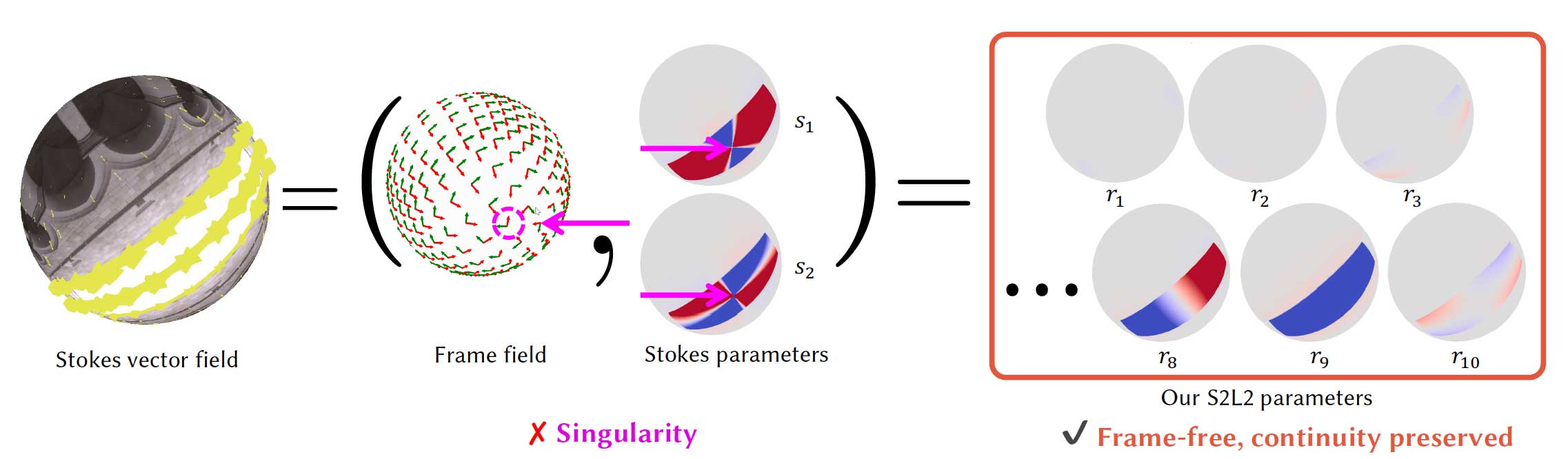
We propose a novel representation for the polarized intensity of rays, named the S2L2 representation. While the conventional Stokes parameter
representation suffers from nondeterministic choices of local frames and a singularity problem in the directional domain, our representation provides the first
frame-free representation of polarized rays, preserving continuity as actual physical quantities. Such guaranteed properties of our S2L2 representation lead to
defining distance and interpolation between polarized rays in different directions, as well as singularity-free polarized radiance fields.
Supplemental video results
Abstract
Stokes parameters are the standard representation of polarized light intensity in Mueller calculus and are widely used in polarization-aware computer graphics. However, their reliance on local frames--aligned with ray propagation directions--introduces a fundamental limitation: numerical discontinuities in Stokes vectors despite physically continuous fields of polarized light. This issue originates from the Hairy Ball Theorem, which guarantees unavoidable singularities in any frame-dependent function defined over spherical directional domains. In this paper, we overcome this long-standing challenge by introducing the first frame-free representation of Stokes vectors. Our key idea is to reinterpret a Stokes vector as a Dirac delta function over the directional domain and project it onto spin-2 spherical harmonics, retaining only the lowest-frequency coefficients. This compact representation supports coordinate-invariant interpolation and distance computation between Stokes vectors across varying ray directions--without relying on local frames. We demonstrate the advantages of our approach in two representative applications: spherical resampling of polarized environment maps (e.g., between cube map and equirectangular formats), and view synthesis from polarized radiance fields. In both cases, conventional frame-dependent methods produce singularity artifacts. In contrast, our frame-free representation eliminates these artifacts, improves numerical robustness, and simplifies implementation by decoupling polarization encoding from local frames.
BibTeX
  @Article{polar:SIGA:2025,
  author  = {Shinyoung Yi, Jiwoong Na, Seungmin Hwang,
             Inseung Hwang, Min H. Kim},
  title   = {Frame-Free Representation of Polarized Light
             for Resolving Stokes Vector Singularities},
  journal = {ACM Transactions on Graphics (Proc. SIGGRAPH Asia 2025)},
  year    = {2025},
  volume  = {44},
  number  = {6},
  }