Designing and Fabricating Color BRDFs with Differentiable Wave Optics
Yixin Zeng
Kiseok Choi
Hadi Amata
Kaizhang Kang
Wolfgang Heidrich
Hongzhi Wu
Min H. Kim
Zhejiang University
KAUST
KAIST
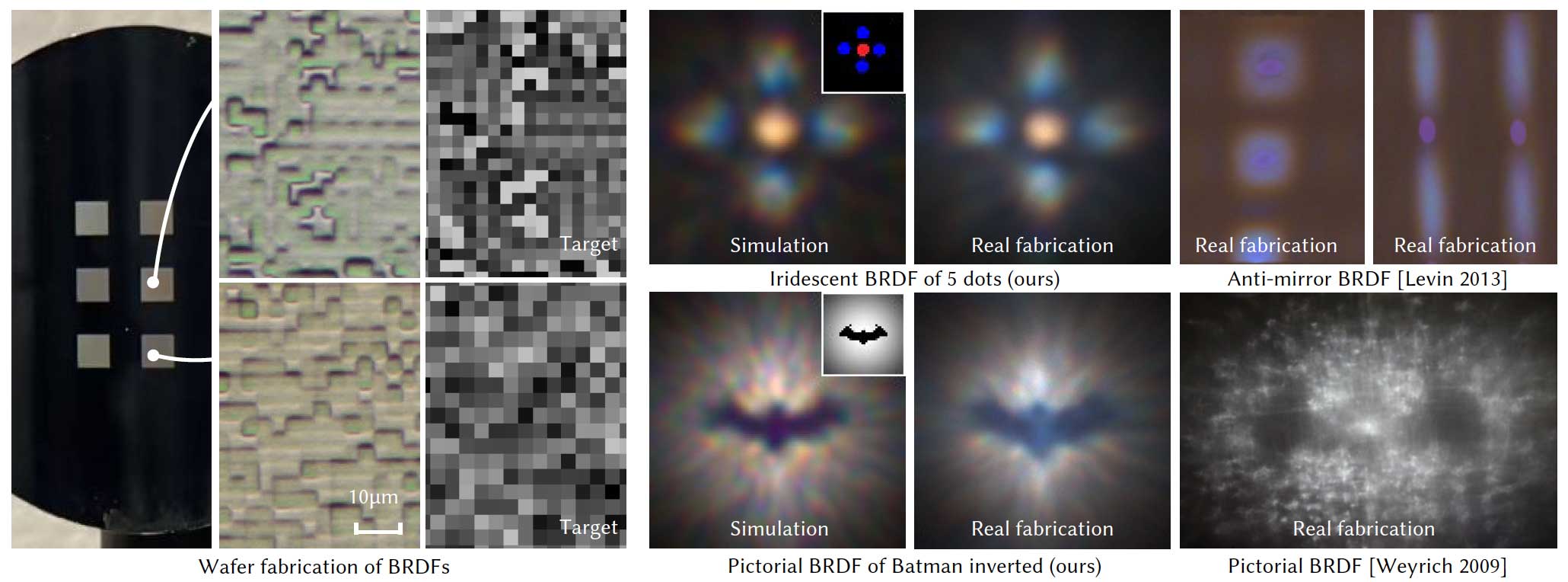
Wafer fabrication of structural color BRDFs. The left three columns show microscopic and height map images of our fabricated wafer, produced using
grayscale lithography at a feature resolution of 1.5–2.0 𝜇m. The fourth and fifth columns present our BRDF simulation (with target insets) and corresponding
real-world fabrication results, demonstrating angularly resolved reflectance with accurate control over both intensity and color. In the top row, we highlight
our iridescent BRDFs–designed to exhibit structural color as a function of viewing direction. These results extend the prior work of the anti-mirror BRDFs by
Levin et al. [2013], which offers no control over the color of the reflected light. In contrast, our method offers programmable angular and spectral control,
producing multicolor effects not possible with prior work. In the bottom row, we demonstrate a pictorial BRDF (Batman inverted) fabricated using our method.
Compared to Weyrich et al. [2009], whose geometric-optics-based method yields lower-frequency grayscale textures, our wave-optical formulation enables
finer spatial resolution and additional color modulation through diffraction. The resulting reflectance pattern more faithfully captures the target image with
enhanced visual contrast and directionality. To our knowledge, this is the first physically validated system capable of fabricating color BRDFs using wave
optics, achieving both angular and spectral control over surface reflectance at micrometer-scale resolution. Refer to the supplemental video for more results.
Supplemental video results
Abstract
Modeling surface reflectance is central to connecting optical theory with real-world rendering and fabrication. While analytic BRDFs remain standard in rendering, recent advances in geometric and wave optics have expanded the design space for complex reflectance effects. However, existing wave-optics-based methods are limited to controlling reflectance intensity only, lacking the ability to design full-spectrum, color-dependent BRDFs. In this work, we present the first method for designing and fabricating color BRDFs using a fully differentiable wave optics framework. Our differentiable and memory-efficient simulation framework supports end-to-end optimization of microstructured surfaces under scalar diffraction theory, enabling joint control over both angular intensity and spectral color of reflectance. We leverage grayscale lithography with a feature size of 1.5--2.0um to fabricate 15 BRDFs spanning four representative categories: anti-mirrors, pictorial reflections, structural colors, and iridescences. Compared to prior work, our approach achieves significantly higher fidelity and broader design flexibility, producing physically accurate and visually compelling results. By providing a practical and extensible solution for full-color BRDF design and fabrication, our method opens up new opportunities in structural coloration, product design, security printing, and advanced manufacturing.
BibTeX
  @Article{brdf:SIGA:2025,
  author  = {Yixin Zeng and Kiseok Choi and Hadi Amata and
             Kaizhang Kang and Wolfgang Heidrich and Hongzhi Wu
             and Min H. Kim},
  title   = {Designing and Fabricating Color BRDFs with Differentiable Wave Optics},
  journal = {ACM Transactions on Graphics (Proc. SIGGRAPH Asia 2025)},
  year    = {2025},
  volume  = {44},
  number  = {6},
  }