International Conference on Computer Vision (ICCV 2025)
Benchmarking Burst Super-Resolution for Polarization Images: Noise Dataset and Analysis
Inseung Hwang
Kiseok Choi
Hyunho Ha
Min H. Kim
KAIST
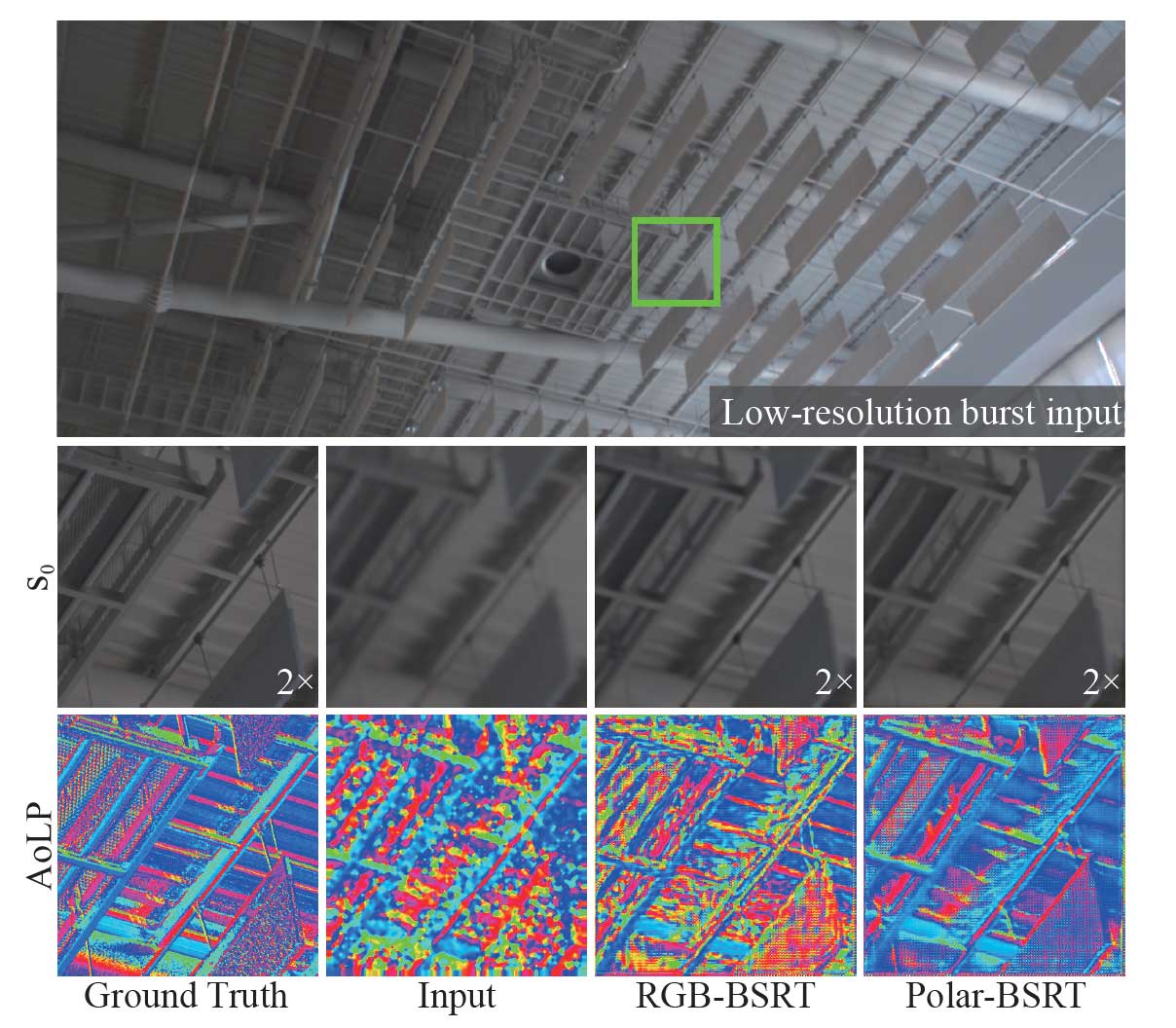
The top row displays the low-resolution burst input captured
using a polarization camera. The second row presents closeup
comparisons of different methods: GT, the low-resolution input,
the 2× super-resolution results of the RGB-trained BSRT
trained on a conventional RGB dataset, and the Polar-BSRT
method trained on our polarization image dataset. Training with
our dedicated polarization dataset significantly improves both the
spatial resolution of the intensity image (s0) and the angle of linear
polarization (AoLP) map, demonstrating the importance of
polarization-specific training for burst super-resolution.
Presentation video (5 min.)
Abstract
Snapshot polarization imaging calculates polarization states from linearly polarized subimages. To achieve this, a polarization camera employs a double Bayer-patterned sensor to capture both color and polarization. It demonstrates low light efficiency and low spatial resolution, resulting in increased noise and compromised polarization measurements. Although burst super-resolution effectively reduces noise and enhances spatial resolution, applying it to polarization imaging poses challenges due to the lack of tailored datasets and reliable ground truth noise statistics. To address these issues, we introduce PolarNS and PolarBurstSR, two innovative datasets developed specifically for polarization imaging. PolarNS provides characterization of polarization noise statistics, facilitating thorough analysis, while PolarBurstSR functions as a benchmark for burst superresolution in polarization images. These datasets, collected under various real-world conditions, enable comprehensive evaluation. Additionally, we present a model for analyzing polarization noise to quantify noise propagation, tested on a large dataset captured in a darkroom environment. As part of our application, we compare the latest burst superresolution models, highlighting the advantages of training tailored to polarization compared to RGB-based methods. This work establishes a benchmark for polarization burst super-resolution and offers critical insights into noise propagation, thereby enhancing polarization image reconstruction. Both code and dataset are publicly available on https://github.com/KAIST-VCLAB/polarns.
BibTeX
@InProceedings{Hwang_2025_ICCV,
   author = {Inseung Hwang and Kiseok Choi and Hyunho Ha and Min H. Kim},
   title = {Benchmarking Burst Super-Resolution for Polarization Images:
           Noise Dataset and Analysis},
   booktitle = {IEEE/CVF International Conference on Computer Vision (ICCV)},
   month = {October},
   year = {2025}
}