Computer Vision and Pattern Recognition (CVPR 2026)
Splat-Based Metal Artifact Reduction in Cone-Beam CT
via Compact Attenuation Modeling
Kiseok Choi
Jaemin Cho
Inchul Kim
Min H. Kim
KAIST
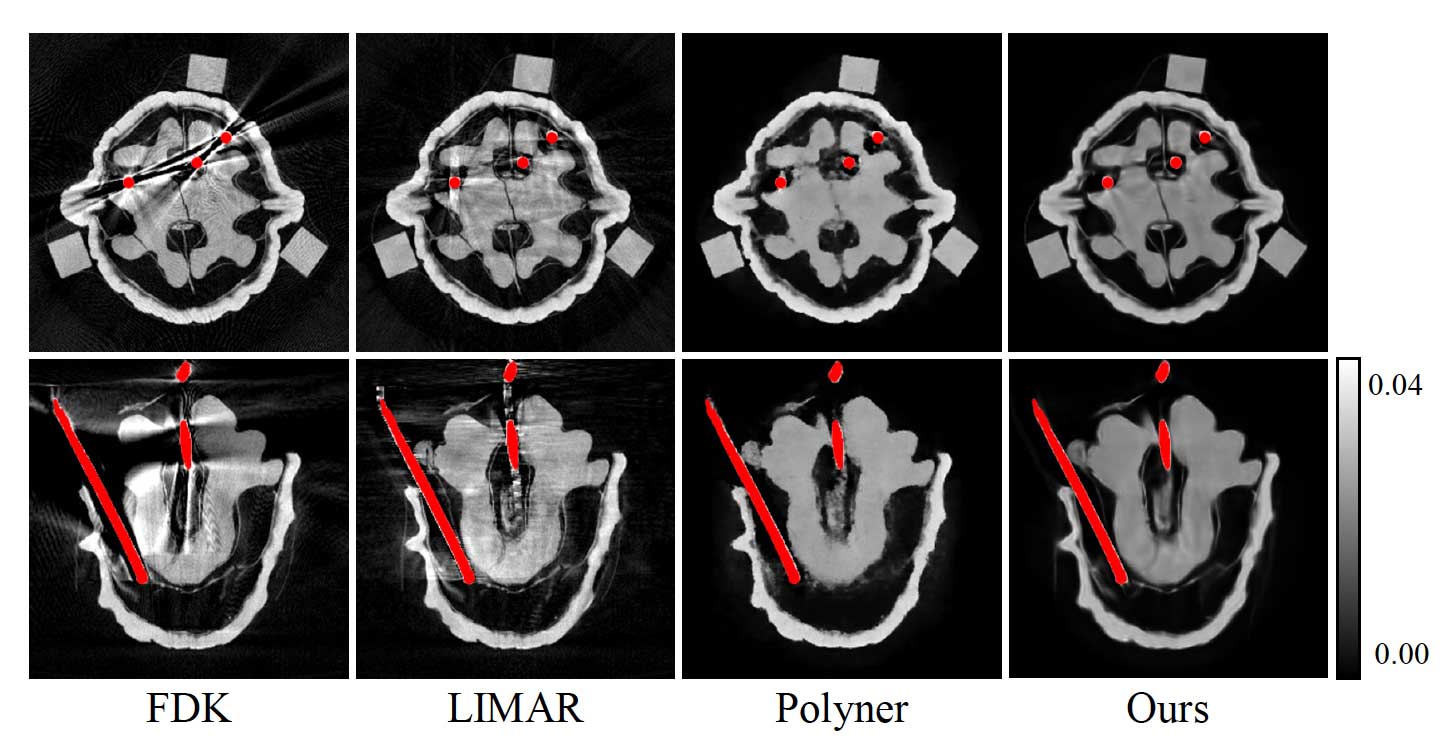
Qualitative comparison of CBCT reconstructions for a
real walnut specimen containing inserted metal pins (highlighted
in red). Each method is shown using a horizontal slice (top row)
and a vertical slice (bottom row). FDK [8], when applied directly
to the metal-inserted scan, produces strong beam hardening artifacts
including dark streaks, severe shading, and distorted intensities.
LIMAR [15] reduces some streaks but noticeably degrades
overall structural fidelity. Polyner [35] removes most streaks, however
it introduces blurring and oversmoothing that wipe out fine
details near metal boundaries. In contrast, our method delivers the
most faithful reconstruction, suppressing metal-induced artifacts
while preserving crisp structural detail in both axial and sagittal
views, demonstrating strong robustness under severe beam hardening
in cone-beam CT.
Presentation
Abstract
X-ray computed tomography (CT) suffers from severe metal
artifacts when high-attenuation objects such as dental fillings
or orthopedic implants are present. These artifacts
originate from the polychromatic nature of X-rays, where
attenuation varies strongly with photon energy and material
composition, breaking the monochromatic assumption used
by conventional reconstruction algorithms. Recent neural
rendering approaches attempt to address this mismatch
through differentiable polychromatic projection models, but
they still struggle with smoothness bias, loss of fine structures,
and prohibitive computation when extended to largescale
cone-beam CT. We introduce a splat-based metal artifact
reduction framework that incorporates a physically
grounded polychromatic forward model into a continuous
Gaussian representation for cone-beam CT. Each Gaussian
encodes the energy-dependent attenuation of the underlying
material using a compact material parameterization, which
enables efficient joint optimization of geometric and material
properties without relying on a metal mask. This compact
attenuation formulation captures the essential variation
across biological tissues and metallic implants, allowing
our model to explain metal-induced nonlinearity while
preserving high-frequency structure. Experiments on simulated
and real cone-beam CT scans show that our method
converges significantly faster and suppresses metal artifacts
more effectively than existing reconstruction and neural
field-based approaches.
BibTeX
@InProceedings{Choi_2026p1_CVPR,
   author = {Kiseok Choi and Jaemin Cho and Inchul Kim and Min H. Kim},
   title = {Splat-Based Metal Artifact Reduction in Cone-Beam CT
            via Compact Attenuation Modeling},
   booktitle = {IEEE Conference on Computer Vision and
      Pattern Recognition (CVPR)},
   month = {June},
   year = {2026}
}